Europe’s 6G Ambition Takes Centre Stage at MWC 2026
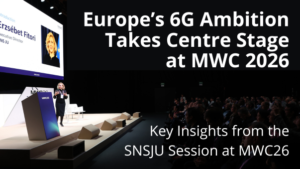
Key Insights from the SNS JU Session at MWC
Barcelona, 2-4 March 2026 – Europe’s vision for next-generation connectivity took centre stage at Mobile World Congress (MWC) in Barcelona, as the Smart Networks and Services Joint Undertaking (SNS JU) held the first session of the Congress. Under the theme ‘6G, Cloud, Edge, AI: The New Power Stack for Industrial Leadership – A European Vision for Future Connectivity,’ the discussion united senior EU policymakers and CxOs industry leaders, to explore how 6G is evolving at the intersection of advanced connectivity, cloud infrastructure, space connectivity, and artificial intelligence.
€1.8 Billion Push for European Leadership
Opening the session, Erzsébet Fitori, Executive Director of SNS JU, set the scene for a forward-looking debate. Colin Willcock, Chair of the SNS JU Governing Board and the 6G Industry Association (6G-IA), made no bones about it: the SNS JU is delivering Europe’s 6G ambitions.
- €1.8 billion in planned investment over the programme’s lifetime.
- Over €630 million already committed, supporting 1,244 entities across 33 countries, with 26% of funding allocated to SMEs.
- A diverse ecosystem extending beyond traditional telecoms, encompassing research institutions, cloud providers, and vertical industries.
- More than 1,000 contributions to global standardisation from SNS JU-backed projects.
- A cohesive European vision for 6G use cases, integrated into the 3GPP standardisation process.
“We Don’t Want to Follow, We Want to Lead 6G”: Willcock’s message was clear: Europe must not merely react to global trends but drive them.
The session left little doubt: Europe is betting big on 6G, not just as a technological upgrade, but as a strategic asset. With China and the US racing ahead in AI and semiconductor dominance, mobile networks remain one of the few areas where Europe still holds a competitive edge. But that lead is far from guaranteed and challenges loom. Funding gaps, regulatory hurdles, and fragmentation between EU member states could slow progress. And with global standardisation battles already underway, Europe’s window to shape 6G’s future is narrowing.
The question now? Whether Brussels and industry can turn ambition into execution, before the next generation of networks leaves them playing catch-up.
From Connectivity to Connecting Intelligence
In the first high-level panel, three of Europe’s top tech leaders, Pallavi Mahajan, Chief Technology and AI Officer at Nokia; Bruno Zerbib, CTIO at Orange Group; and Damien Lucas, CEO at Scaleway, delivered a stark message: AI is forcing a complete rethink of network architecture, but success hinges on trust, energy, and long-term investment.
AI Demands a Network Overhaul
Mahajan set the tone: over 50% of AI traffic now comes from mobile devices, yet its behaviour is nothing like traditional data. “AI isn’t an add-on, it must be baked into the network’s core,” she said, warning that agentic AI will only accelerate this shift.
Without Trust, 6G Fails
Zerbib complemented this point, though, with a warning: “You can build the most advanced network, but if customers don’t trust it, they won’t use it”. For Orange, privacy, data sovereignty, and secure AI controls are non-negotiable, especially in Europe, where regulatory scrutiny is intense. He added that European sovereignty in AI networks requires more than infrastructure: “We need models trained on European data, under European rules.”
The Energy-Storage-Network Trilemma
Lucas framed the challenge as a three-part “power stack”: compute (for AI workloads), storage (for instant data access), and networks (for reliability). “All three must scale together, or the system breaks,” he said, stressing that energy efficiency is now a survival issue for data centres.
The Investment Warning
All three leaders agreed: Europe’s 6G ambitions risk stalling without sustained funding and policy stability. Europe has strong research capabilities and highly skilled talent, but translating innovation into global impact requires sustained investment and policy continuity.
“2028 isn’t the finish line, it’s just the start,” Mahajan said. Zerbib added: “If we treat this as a short-term project, we’ll lose to the US and China.”
Europe’s Digital Sovereignty at Stake
Renate Nikolay, Deputy Director-General of the European Commission’s DG CONNECT, delivered a bold assessment in her opening keynote at Mobile World Congress 2026: Europe’s leadership in connectivity is under threat unless urgent, coordinated action is taken.
While Europe retains strong industrial capabilities in connectivity, Nikolay warned that its dependence on non-European providers for cloud services, AI infrastructure, and semiconductors creates a strategic vulnerability. To safeguard its position, she called for continuous investment and unified policy efforts, citing recent and upcoming legislative measures as critical tools in this push.
In a subsequent discussion with Erzsébet Fitori, Executive Director of the SNS JU, Nikolay stressed the importance of translating Europe’s research excellence into large-scale industrial applications. She described public-private partnerships, such as the SNS JU, as essential mechanisms for aligning policy objectives with industry demands, thereby accelerating the deployment of advanced technologies.
“Europe is a powerhouse in research, but we must ensure these breakthroughs reach the market,”: Nikolay asserted, underscoring the need for closer collaboration between policymakers, researchers, and businesses.
As the conference progresses, her keynote served as a reminder: Europe’s digital future will depend not just on technological prowess, but on its ability to execute a cohesive, long-term strategy.
Resilience Through Integrated Networks
The second panel moderated by Thibaut Kleiner, Director for Future Networks at DG CONNECT, brought sharp focus to Europe’s struggle to maintain technological leadership in the race toward 6G. While the continent boasts strong capabilities, industry leaders warned that failure to scale innovations, secure networks, and build trust could leave it trailing behind global rivals.
Mikael Bäck, VP and Corporate Officer, Ericsson, insisted that Europe must commit to sustained investment and a long-term vision, or risk falling further behind in the 6G era. His warning was echoed by Cayetano Carbajo, Director For Core, Transport and Service Platforms at Telefónica, who acknowledged that Europe does not dominate every critical technology shaping 6G but argued that strategic infrastructure investment could help close the gap.
The discussion moved to resilience, with Quentin van de Geer, VP Engineering at Airbus Defence & Space, emphasising the need to merge terrestrial and non-terrestrial networks to ensure uninterrupted connectivity, even in extreme conditions. Laurent Jaffart, Director of Resilience and Connectivity at the European Space Agency (ESA), built on this, explaining that space-ground integration could not only enhance reliability but also enable entirely new services that leverage both domains.
Security and Trust: Non-Negotiable for 6G
Security and trust emerged as non-negotiable priorities, with panellists stressing that operators already support critical services, making them prime targets for cyber threats. The discussion highlighted that access to high-quality network data will be essential for training AI systems that underpin future connectivity. Without it, Europe’s ability to deploy secure, AI-driven networks could be severely limited.
A Three-Part Strategy for Europe’s 6G Ambitions
The panel coalesced around three critical priorities for Europe’s 6G future. First, developing viable business models to sustain long-term investment in experimental and scalable infrastructure and innovation. Second, scaling breakthroughs from research labs to real-world deployment at speed. Third, maintaining trust through robust security, data sovereignty, and transparent governance, without which, even the most advanced networks may fail to gain adoption.
The overarching message was clear: Europe’s 6G success will depend not just on technological excellence, but on its ability to execute a cohesive strategy, one that balances investment, resilience, fully integrating AI and trust in an increasingly competitive global landscape.
Looking Ahead
In her closing remarks, Erzsébet Fitori reaffirmed that Europe delivers when policy, research and industry align. Continued investment in research, experimentation and large-scale pilots is needed to translate technological advances into new services and viable markets.
We need a public–private partnership which coordinates complexity and turns collaboration across borders into competitive strengths.
A European model where:
- Sustainability is not an afterthought but a design principle
- Real users, our industry verticals, validate features in live environment
- Fragmentation is addressed not through centralization, but through federated pan-European infrastructures
The session concluded with the announcement of the newly selected SNS JU projects, representing €116 million in additional EU funding, reinforcing Europe’s push to shape global 6G standards and strengthen its digital sovereignty.
This brings total EU public funding under Horizon Europe to €630 million since 2021, expanding the SNS JU portfolio to 100 projects, with a further €270 million planned for 2026 and 2027.
These projects will serve as a critical test of Europe’s ability to turn ambition into action, ensuring that its vision for 6G, AI-driven networks, and digital sovereignty translates into tangible progress.
The good news is that SNS JU Call for proposal 2026 is currently open and will accept submissions until 29 April 2026.
Looking ahead, the 2027 SNS JU flagship call will mobilise more than €230 million in EU public funding to push the next phase of European 6G development, aiming to demonstrate system-level integration and pre-commercial validation of 6G capabilities, strengthening Europe’s industrial ecosystem and preparing the ground for future standardisation and deployment of 6G systems.
From Lab to Live Demo: SNS JU Projects Showcased at MWC 2026
In addition to the high-level debate on Europe’s future connectivity ambitions, the real action unfolded on the exhibition floor of MWC. There, the SNS JU projects transformed abstract research into tangible, interactive demonstrations, offering a glimpse of how AI, cloud-native networks, and next-generation hardware are already taking shape. Among them 6G-SANDBOX and IMAGINE-B5G, showcasing AI-driven optimisation for radio access networks, using machine learning to dynamically adjust performance in real time. CENTRIC presented digital twin environments that predict Massive MIMO behaviour, allowing engineers to test configurations before physical deployment. 6G-VERSUS and UNITY-6G explored channel state compression and early 6G FR3 air-link experiments, proving that high-fidelity emulation is becoming as critical as real-world testing. 6G-REFERENCE unveiled hardware innovations designed to improve spectrum efficiency, including integrated circuits and antennas that use dynamic frequency filtering to minimise interference. 6G-EWOC pushed the boundaries of integrated sensing and communication (ISAC), demonstrating MEMS-based LiDAR systems that combine high-precision sensing with free-space optical communication, a potential game-changer for autonomous vehicles and smart cities. SUNRISE-6G presented its European 6G experimentation platform, now recognised as contributing to the ETSI Software Development Group. The project’s Operator Platform, a major milestone—supports federated testbeds and inter-operator collaboration, aligning with GSMA standards to ensure seamless integration.
6G-DALI introduced its vision for a European 6G Data Space, designed to democratise access to open datasets and fuel AI experimentation across the continent. 6G-INTENSE revealed its TM Forum Catalyst project, exploring how intent-based automation can simplify the management of distributed edge networks. 6GBot, an intent-driven orchestration solution, showcased how AI can automate complex network tasks.
National Pavilions and Industry Pioneers
MWC is not only a showcase of cutting-edge technology but also a vital forum for strategic collaboration and innovation. The event provided a unique opportunity to engage with Ministers from the Netherlands and from Finland, alongside leaders of the German 6G Programme, the France 6G and the Finnish 6g Bridge Program, offering critical insights into their respective 6G roadmaps, activities, and investment frameworks.
Equally, MWC served as an unparalleled platform to explore the latest breakthroughs from Europe’s leading innovators, including Ericsson, Nokia, Airbus, the European Space Agency (ESA), and Deutsche Telekom. Their advancements underscored Europe’s capacity to drive global standards in connectivity, sustainability, and next-generation services—solidifying the continent’s role at the forefront of the digital era.
You can watch the full SNS JU Session at MWC26 on our YouTube Channel: SNS JU at MWC26: Full Session. 2 March 2026