Looking back at Techritory 2026
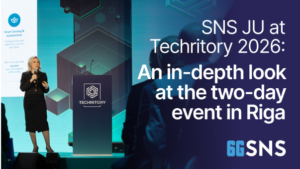 Riga once again brought together European and International policymakers, industry leaders, researchers and innovators to discuss how digital transformation and connectivity can contribute to Europe’s security, resilience and prosperity. The event once again provided an important platform for dialogue, cooperation and partnership-building across sectors and borders.
Since its launch in 2018, Techritory has developed into an international forum, bringing together more than 2,000 participants from 55 countries. By connecting key stakeholders from across the European Union and beyond, it helps foster exchange, support collaboration and turn shared ambitions into concrete action.
At this year’s edition, the Smart Networks and Services Joint Undertaking (SNS JU) and its community made a strong contribution through co-creation sessions, panel discussions, a welcome address at the opening ceremony as well as a series of podcasts. Together, these activities highlighted Europe’s path towards 6G requires strong collaboration, large-scale validation and a diverse, highly skilled workforce.
Building the change towards 6G
“Techritory is the place where ideas become partnerships and partnerships become impact.”
Opening Techritory 2026 with this message, Raivis Melnis, Latvia’s Minister of Defence, cast innovation not simply as ambition, but as a strategic capability.
That sense of urgency and purpose carried through the event’s opening session. In her welcome address, Erzsébet Fitori, Executive Director of the Smart Networks and Services Joint Undertaking, made clear that Europe does not intend to stand by as the next technological revolution unfolds. “We are building the change, not waiting for the change,” she said.
For Fitori, 6G is far more than the next step in connectivity. It is a decisive moment for Europe’s technological future. “6G will be a game changer for Europe, for European companies and citizens,” she said. “It won’t be just fast networks: it will be the nervous system of the AI economy.”
Her message was clear: the technologies now being developed will shape not only how Europe connects, but how it competes, innovates and strengthens its resilience in the years ahead.
 She pointed to the vast potential of 6G across the economy and society, from integrated networks spanning space, air and sea, to drone swarms, digital twins, smart logistics and smart farming. The promise, she suggested, is twofold: improving daily life for citizens while reinforcing Europe’s competitiveness and economic security.
Fitori also used the occasion to announce the next wave of SNS JU projects, backed by EUR 22 million under Horizon Europe. The new initiatives — 6G-AID, HEMES-6G, EUBICON-6G, 6G EU-India BRIDGE and SNS IMPACT — are intended to help turn Europe’s 6G ambitions into concrete results. A further microelectronics project, supported by an additional EUR 14 million, is also expected to be announced shortly. Looking ahead, around 20 more projects are expected to start in 2027, with a strong emphasis on large-scale pilots and trials. This focus on pilots and vertical sectors will also be reflected in the 2027 Work Programme, with the next call for proposals expected in January 2027.
Highlights from the SNS sessions
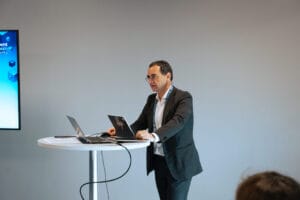
Building the future workforce for AI and 6G. The co-creation session opened with a keynote by Miguel Gonzalez-Sancho, Head of Unit at DG CONNECT, who explained that 6G will bring AI to the edge and that the risks of this evolution call for transparency, accountability and diversity. “When it comes to the workforce, we need more diversity, not only for innovation and competitiveness, but also to address the risks brought by AI and 6G,” he said. The session also showcased the SNS Women in Telecommunications and Research (WiTAR) Working Group, now counting 163 active members from 49 projects. The closing panel agreed that Europe needs a system-level view of technology, cross-disciplinary skills and, above all, ways to spark young people’s curiosity about engineering.
6G trials for a resilient Europe. Led by Carles Anton (CTTC) and Raffaele de Peppe, this session looked at how SNS pilots can pave the way to large-scale pre-deployment under FP10. Project 6G-VERSUS shared its key lesson: resilience is not a single network feature, but must be built into architecture, experimentation and service operation from the start. Telefónica presented its Mission Critical Dome, designed to support local authorities in ar eas hit by floods and natural disasters.

EU tech resilience and sovereignty. Moderated by Colin Willcock, Chairman of the 6G Infrastructure Association, the panel discussed which parts of the digital value chain Europe needs to control. Speakers from industry, defence, civil society and the Commission converged on the importance of standardisation, interoperability, cooperation and a stronger single market. As Miguel Gonzalez-Sancho put it,
Europe must “fund the right things, and do it in the right way”, acting together.
Beyond networks: the economic and social impact of 6G. Moderated by Raffaele de Peppe, 6G-IA Vice Chair, this panel explored how 6G can create measurable value. GSMA explained that 6G will be the first generation able to sense, reason and act, building on a mobile sector that contributed around EUR 200 billion to the EU economy in 2025. On monetisation, AI as a service emerged as a key opportunity, with Colin Willcock noting that “we will need 6G just to handle the tsunami of AI traffic.”
SNS podcasts. The SNS community also recorded podcasts on 6G trials, inclusive leadership, measuring 6G’s real value and autonomous AI-enabled networks, with two more episodes to be released online. You can find the podcasts here: https://open.spotify.com/show/2N8sgSDnOtbXHkgH8Prw9M?si=46787540f04a44ab
Looking ahead.  Techritory 2026 made one thing clear: Europe’s road to 6G will not be defined by technology alone. It will be shaped by people, built on trust and tested through resilience. And as the SNS JU moves into the final phase of its programme, its message from Riga is unmistakable: the future will not be something Europe waits for, but something it builds.
To see how that future is already taking shape, discover the SNS Journal 2026 and explore the SNS JU Projects’ Top 10 Key Achievements 2026.