

SNS JU January 2026 Newsflash
In this last newsflash of January 2026, find back
-
- a recap of events where SNS JU or the 5G and 6G communities have an impact,
- join the discussion followed by SNS JU projects news
- and do not miss any coming events in the Save-the-Dates !
SNS JU and transversal News
SNS JU Calls for Proposals 2026 – Info Day & Brokerage Event

On 2 February 2026, the SNS JU held an online Info Day and Brokerage event to inform potential participants about the SNS Project Call 2026 (SNS Call 6) and let applicants know about the funding opportunities within the R&I Work Programme 2026 of the Smart Networks and Services Joint Undertaking (SNS JU), and to assist those interested in submitting a proposal.
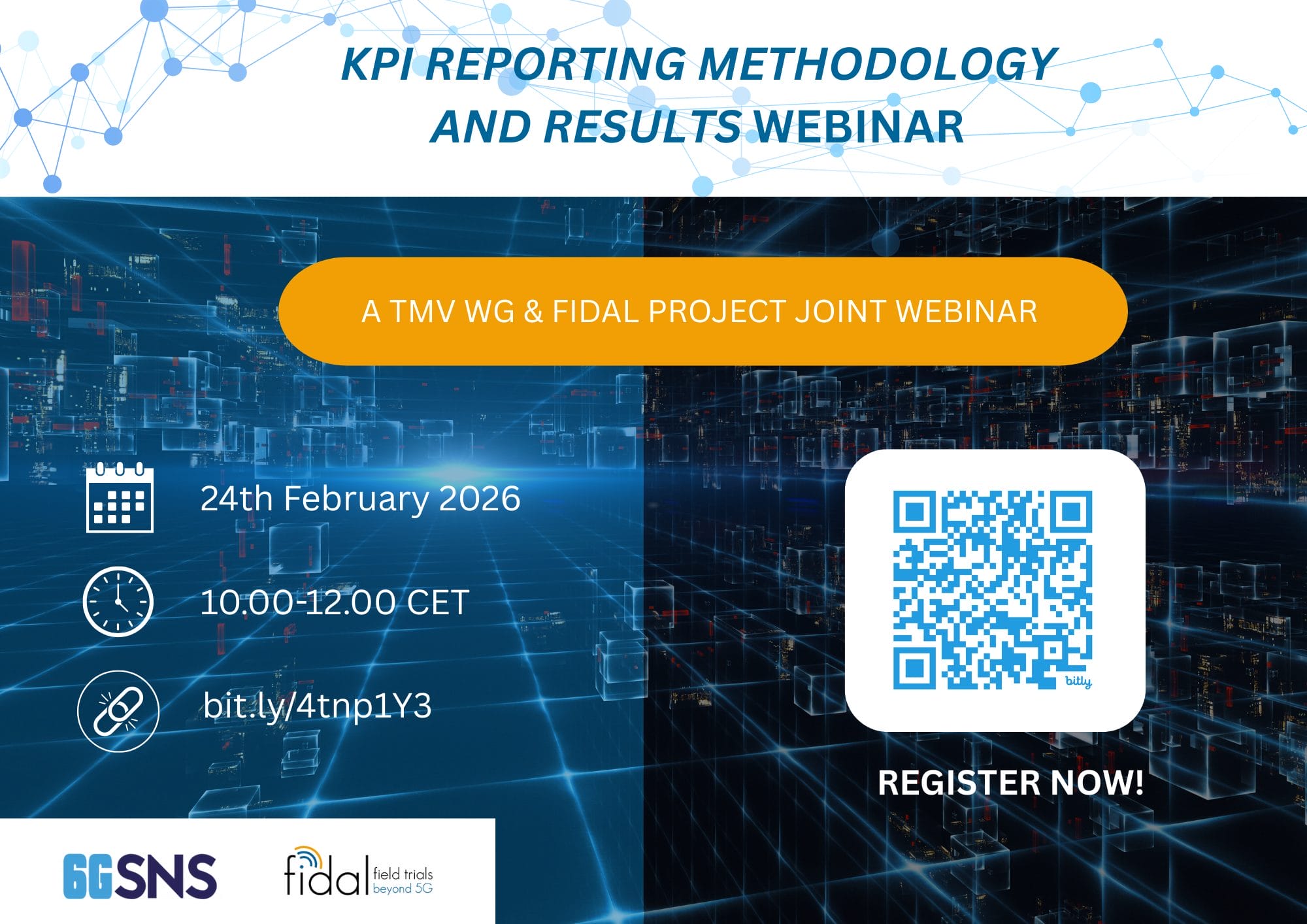
Webinar – KPI reporting methodology and result
The SNS JU TMV Working Group and the FIDAL Project are jointly hosting an online webinar focused on KPI reporting methodology and the latest results. The session will share inputs from the TMV WG’s ongoing work, alongside project-specific insights and lessons learned.
When: 24 February 2026, 10:00–12:00 CET
Where: Online
Presenting projects: 6G-BRICKS, 6G-SANDBOX, ENVELOPE, IMAGINE-B5G, ISEE-6G, and FIDAL.
Call for Experts 2026: SNS JU is looking for evaluators for its EU research Projects

The SNS JU is looking for experts to evaluate project proposals and monitor ongoing projects in the field of beyond 5G, 6G technology and smart networks and services.
SNS JU opens its sixth Call for Proposals
The Smart Networks and Services Joint Undertaking (SNS JU) pens its sixth Call for Proposals, with €22 million in grants to advance 6G Research and Development. This funding will focus on five strategic priorities outlined in the SNS JU R&I Work Programme 2026, published last December. These priorities include topics for research and innovation in 6G devices, AI integration, and advanced testbeds; Global standards positioning, and international partnerships (focusing on India); Coordination and Support Actions (CSA), emphasising consolidation of SNS JU results.
Interested participants can apply via the EU Funding & Tenders Portal from 29 January until 29 April 5pm CET.

WiTaR Lunch Salon #3 – Building Inclusive 6G Through Technical Leadership, Research Collaboration and Contributions to Standardisation
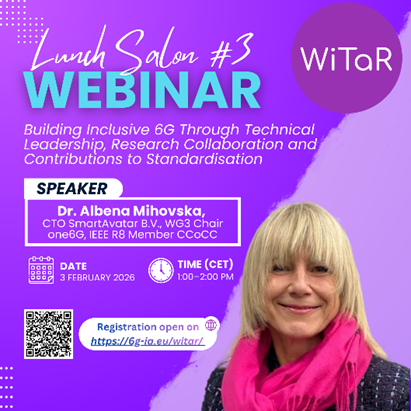
The WiTaR Lunch Salon #3 took place online on 3 February 2026 (13:00–14:00 CET), focusing on how technical excellence and inclusion jointly drive the future of 6G.
The session featured Dr. Albena Mihovska, CTO of SmartAvatar, WG3 Chair at one6G, and IEEE R8 Conference Coordination Committee member. Drawing on her long-standing involvement in 6G research and international standardisation, she highlighted the path from advanced research to standards impact, and how diverse perspectives strengthen innovation, security, and sustainability.
Organised within the WiTaR initiative of the 6G Smart Networks and Services Industry Association (6G-IA) community, the event aims to encourage inclusive technical leadership across the emerging 6G ecosystem.
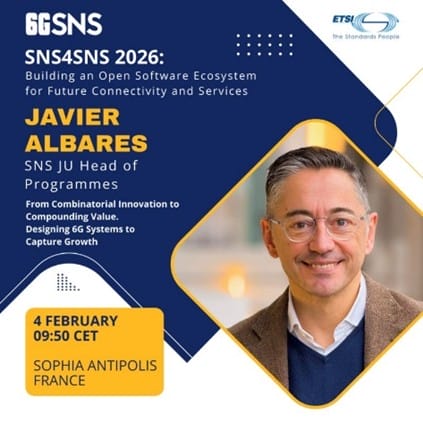
SNS JU on stage at SNS4SNS 2026 in Sophia Antipolis
The Smart Networks and Services Joint Undertaking (SNS JU) participate actively in the Software & Standards for Smart Networks & Services 2026 (SNS4SNS 2026), organised by ETSI and taking place from 2 to 5 February 2026 in Sophia Antipolis, France.
On 4 February (9:30–10:30), SNS JU contribute to Session 1: “Building an Open Software Ecosystem for Future Connectivity & Services”, highlighting the EU approach to converging digital communications and the role of open software, research, and standards in shaping future 6G systems. Contributions will include a keynote intervention by Javier Albares, Head of Programmes at SNS JU, focusing on designing 6G systems to capture long-term value
New SNS JU White Paper: the AI/ML Landscape for Smart Networks and Services

SNS JU has released a new white paper titled “The AI/ML Landscape for Smart Networks and Services”, developed by its Reliable Software Networks Working Group. The publication examines how Artificial Intelligence (AI) and Machine Learning (ML) are shaping the evolution of smart networks, with a particular focus on future 6G systems.
Positioned as a primer, the white paper clarifies key AI/ML concepts, reviews major ongoing standardisation efforts, and highlights open implementations and innovation pathways. Its objective is to provide a common reference for researchers, industry stakeholders and policymakers, helping to align initiatives and accelerate the development of AI-native networks within the SNS JU research framework.
The paper also emphasises the role of AI/ML in improving network performance while addressing critical challenges such as security, trust and sustainability in next-generation communication networks.
Launch of the SNS CO-OP Podcast

The SNS CO-OP Podcast is now live on Spotify, offering a new platform to share insights on the future of 6G in Europe.
The first episode, recorded at Techritory Forum 2025 in Riga, focuses on Integrated Sensing and Communications (ISAC) and its transition from research to real-world 6G deployments. The discussion covers technical challenges, standardisation, AI-driven sensing, privacy and interference management, as well as emerging business models such as sensing-as-a-service.
Featuring contributions from Multi-X, iSEE-6G, Hexa-X-II, and GSMA Intelligence, the podcast supports the mission of SNS CO-OP, an EU-funded Horizon Europe project fostering collaboration for 6G smart networks and services.
Workshop on Agentic AI and network impact announced for MWC 2026

NetWorldEurope and China Communications Standardization Association (CCSA) will host a joint workshop on Agentic AI and its impact on future networks on 4 March 2026, during MWC26 in Barcelona.
The event (onsite with limited seats + online) will examine emerging Agentic AI use cases, autonomous networks, and standardization trends, through two expert discussion panels bringing together industry and academic leaders. Key contributors include Rui L. Aguiar (NetWorldEurope) and Ku Wen (CCSA).
Registration is open. The final agenda and access details will be shared with registered participants.
EU-Japan Digital Week 2026: advancing strategic digital cooperation
The EU-Japan Digital Partnership will host the EU-Japan Digital Week 2026 from 23 to 30 March 2026 in Tokyo. As the flagship annual event of the partnership, it will gather policymakers, industry leaders, researchers and academics from Europe, Japan and the Indo-Pacific region.
The 2026 edition will focus on key digital priorities, including AI, semiconductors, quantum and high-performance computing, cybersecurity, trusted data spaces and digital diplomacy. Through policy dialogues, thematic workshops, hackathons and stakeholder roundtables, the event aims to strengthen joint research, innovation and policy alignment in support of a secure, resilient and human-centric digital future.

PACET 2026 highlights Optical innovations for 6G and AI networks

The PACET 2026 (8th Panhellenic Conference on Electronics & Telecommunications) will take place on 23–24 April 2026 at the University of Patras, focusing on cutting-edge advances in electronics and telecommunications.
Among the highlights, Ioannis Tomkos will deliver a keynote on energy-efficient optical interconnects for AI data centers and future 6G networks, showcasing innovations in analogue optical signal processing (AOSP) and optical DACs (oDACs) aimed at ultra-high speed and ultra-low power transmitters and switches. The work draws on EU-funded research projects, including FLEX-SCALE and PROTEUS-6G.
PACET 2026 invites researchers and students worldwide to submit original papers and posters (IEEE format), with a submission deadline of 9 February 2026. Accepted papers will be published in IEEE Xplore, with selected contributions considered for journal special issues.
EuCNC & 6G Summit 2026: Calls for contributions now open
The EuCNC & 6G Summit has officially opened its calls for contributions for the 2026 edition, inviting submissions across papers, workshops, tutorials, demos, posters, pitches, exhibitions and awards.
Key deadlines include (extended: 23 January 2026) 13 February for regular papers; 6 February 2026 for proposals for workshops, special sessions ,tutorials and travel grant applications; 6 March 2026 for poster extended abstracts; and 27 March 2026 for startups, PhD theses, demos, exhibitions, and booth pitches.
Taking place in June 2026, the conference will cover the full spectrum of telecommunications, from 5G deployment and IoT to 6G research, experimentation and testbeds. Accepted papers will be published in the proceedings and submitted to IEEE Xplore, with best paper and booth awards granted. As a not-for-profit event, EuCNC & 6G Summit keeps registration fees low, reinvesting surpluses into participant grants.

REFRESH 2026: Call for Papers Open

The 6th International Workshop on Real-Life Modeling in 5G/6G Networks and Beyond (REFRESH 2026) has opened its Call for Papers. The workshop will take place on 22–24 June 2026 in Reykjavik, Iceland, co-located with DCOSS-IoT 2026.
REFRESH 2026 focuses on real-world modeling, experimentation and deployment-driven insights for 5G, B5G and emerging 6G networks. Topics include measurements and testbeds, digital twins, AI/ML for network optimization, edge computing and IoT, performance evaluation, and lessons learned from operational deployments.
Key dates: paper submission by 5 April 2026, acceptance notification on 30 April 2026, and camera-ready papers due 8 May 2026. The programme will also feature keynote talks from leading experts in academia and industry.
Publication of the 6G Promotion Project Frequency White Paper
The 6G Promotion Project of the XG Mobile Promotion Forum (XGMF) has published its Frequency White Paper (December 2025), outlining key initiatives for the early allocation of spectrum essential to 6G and identifying candidate frequency bands for future 6G deployment.
Based on the recommendations set out in the white paper, the 6G Promotion Project submitted input to the Ministry of Internal Affairs and Communications on the draft Frequency Reorganization Action Plan (FY2025). The final version of the Action Plan, published in late November, reflects these contributions.
This publication aims to support the securing of critical spectrum resources for 6G and to contribute to the advancement of global 6G communications.
VFCS 2025: Publication of the post-event summary report
NetWorldEurope has released the post-event summary report of the Visions for Future Communications Summit 2025 (VFCS 2025), held in Lisbon on 25–26 November 2025.
Organised with the support of 6G-IA, SNS CO-OP, the European Commission, and IEEE, the Summit gathered experts from academia, industry, and public bodies to discuss research and societal challenges for communications beyond 2030.
The report synthesises key insights from keynotes and panels and provides strategic input to the update of the NetWorldEurope Strategic Research and Innovation Agenda (SRIA), supporting the preparation of FP10 and Europe’s long-term priorities in smart networks and services.
Launch of ETSI research and innovation awards

In early 2026, ETSI launched its first Research and Innovation Awards to recognise outstanding contributions from the research community to ETSI’s standardisation activities.
The awards cover three categories: a publicly funded collaborative R&I project contributing research results to ETSI standards or software; an individual contributor integrating research or innovation into ETSI deliverables; and a young researcher under 30 whose academic or research work has impacted ETSI standardisation or software.
The call for nominations opened on 6 January and closed on 16 February 2026. The awards will be presented at the EuCNC & 6G Summit in June 2026.
For more details on the initiative, including the eligibility criteria for the awards, please visit ETSI – Research & Innovation for ICT standardisation work.
5G Strategic Deployment Agenda for Connected and Automated Mobility (CAM) on Roads
On 8 January 2026, the Smart Networks and Services Joint Undertaking (SNS JU) published the 5G Strategic Deployment Agenda (SDA) for Connected and Automated Mobility (CAM) on Roads, setting a common framework for large-scale 5G rollout along Europe’s major road networks.
The agenda defines how to deploy 5G connectivity across TEN-T “5G corridors”, enabling advanced CAM use cases with seamless, cross-border service continuity. It provides guidance on investments, cooperation models and deployment roadmaps, and supports six service areas, including road CAM, logistics, digital twins, connected passenger services and software-defined vehicles.
Approved by the SNS JU Governing Board, the SDA aligns with EU digital mobility policies and builds on lessons from CEF Digital co-funded 5G corridor projects (2022–2025). It follows the 2024 5G SDA for Rail, reinforcing SNS JU’s role in coordinating pan-European 5G corridors and accelerating connected and automated mobility in Europe.

6G-IA contribution to the SCoDIHNet paper under the SNS CO-OP project
Under the SNS CO-OP framework, the 6G-IA has contributed to the paper Smart Connectivity Testbeds Use by DIHs (Digital Innovation Hubs), published by SCoDIHNet in cooperation with the Testing and Experimentation Environments Working Group of AIOTI.
The paper aims to support Digital Innovation Hubs in identifying nearby smart connectivity experimental facilities across Europe to develop and validate innovative use cases. It highlights the opportunity offered by advanced testbeds deployed through European-funded projects, while also outlining key considerations such as access conditions and the sectoral specialisation of platforms.
NetWorldEurope SME Working Group – 2025 in Focus, 2026 Underway
Throughout 2025, the NetWorldEurope SME Working Group continued efforts to enhance SME visibility and coordination within the Smart Networks and Services (SNS) ecosystem. Key outcomes included the publication of the 2025 European SME Expertise in 5G and Beyond brochure, participation in EuCNC & 6G Summit 2025, and the organisation of six working group meetings supporting alignment and knowledge exchange.
In parallel, regular communication activities were carried out to disseminate news and opportunities for SMEs, including targeted awareness campaigns and an active social media presence, with a transition from X to Bluesky. The year concluded with the release of a short YouTube video summarising the main highlights of 2025.
In 2026, activities resumed with the first working group meeting held on 8 January, marking the launch of the annual work programme and the alignment of priorities for the 2026 roadmap.

SNS projects at 5G-6G events
6G-REFERENCE launches Webinar series with Joint Session on 6G hardware innovation
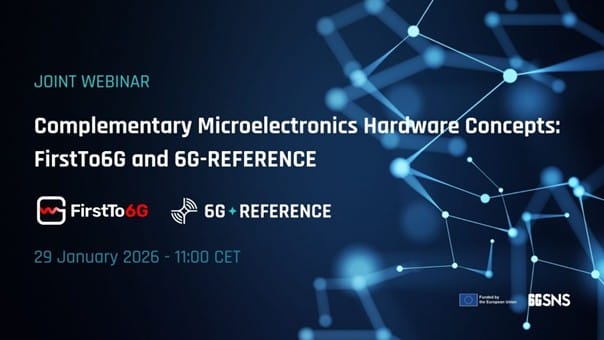
The first 6G-REFERENCE Webinar Series, jointly organised with FirstTo6G, took place on 29 January 2026, bringing together leading researchers and innovators to discuss how complementary microelectronics hardware approaches can accelerate the development of future 6G systems.
Supported under the SNS JU, the webinar showcased the goals and early achievements of both projects, with a strong technical focus on fully wireless radio units for distributed MIMO, advanced time-modulated transmit and receive array techniques, and 6G-enabling data converters.
An interactive panel discussion concluded the session, highlighting synergies between 6G-REFERENCE and FirstTo6G and identifying opportunities for wider collaboration across the SNS JU ecosystem. The event marked the successful launch of the 6G-REFERENCE webinar series and underlined the importance of cross-project cooperation in advancing key hardware building blocks for next-generation 6G networks.
SUSTAIN-6G to lead PT-Sustain-ICT 2026 on sustainable photonic networks

SUSTAIN-6G project will organise the PT-Sustain-ICT 2026 workshop, held in conjunction with PHOTOPTICS 2026, focusing on photonic technologies for sustainable by design ICT and future 6G networks.
Building on Sustain-6G research, the workshop will highlight how energy efficient optical technologies can reduce ICT energy consumption across access, core networks and data centres, while integrating environmental and societal indicators alongside performance KPIs.
Topics include optical wireless communications, PON and POL, WDM systems, optical sensing and QKD.
one6G Open Lecture 11 Explores NTN–TN Convergence for 6G
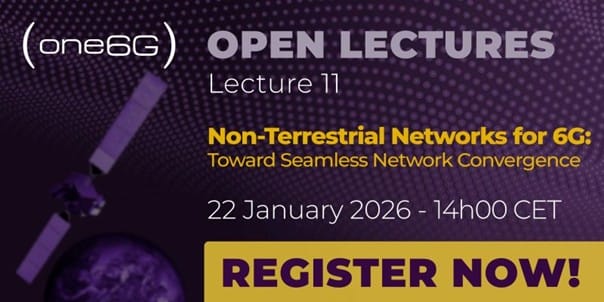
The one6G Association held Open Lecture 11 on 22 January 2026, focusing on the role of Non-Terrestrial Networks (NTNs) in enabling seamless convergence with terrestrial networks in future 6G systems.
The session examined how satellites, high-altitude platforms and UAVs can be fully integrated with terrestrial infrastructures, moving beyond 5G extensions toward truly converged TN–NTN architectures. Discussions highlighted the potential of this approach to deliver ubiquitous and resilient connectivity, support sustainability objectives and help reduce the digital divide.
Moderated by Malte Schellmann (Huawei Technologies), the lecture featured insights from Tomaso de Cola (DLR, 5G-STARDUST project coordinator), Miguel Ángel Vázquez Oliver (CTTC) and Alessandro Vanelli-Coralli (6G-NTN project coordinator), covering architectural choices, practical constraints and standardisation challenges for integrated 6G networks.
SCoDIHNet news
The Smart Connectivity DIH Network has been primarily active on the following topics:
- First meeting of the year – 13 January
The first meeting of the year focused on several key areas:
- Update of the Vertical Engagement Tracker (VET):
The SNS VET has been enhanced with the integration of replicability information. DIHs and other users can now easily filter replicable use cases. SNS projects wishing to introduce a new replicable use case can use the Online Replicability Assessment Tool (RAT) to determine its Replicability Level (RL), which is then linked to the corresponding use case in the VET. - Cooperation with the DTA TWG Smart Connectivity (EDIH 2.0):
Andrea Aler Tubella, Chair of the Smart Connectivity Thematic Working Group, reported on the launch of EDIH 2.0. The new support action in charge of EDIH 2.0 is currently setting up a revised working group structure aimed at avoiding gaps and overlaps. This new organization and the associated working groups are expected to be established in the coming weeks. - Preliminary results of the DIH expectations survey:
The SCoDIHNet and SCTWG jointly launched a survey to better capture DIHs’ expectations in terms of services. Initial results highlight five priority service areas: co-development of proposals for EU calls (12 responses), community building and awareness (11), technology updates and use cases (10), information on EU instruments and calls (8), and strategy development (8). - Action plan:
The groups agreed to maintain a living update of the service catalogues and to identify concrete actions to jointly address the five priority service needs identified.
- Progress on replicable use cases
Since the beginning of the year, three projects have contributed five new replicable use cases, each with an associated replicability level. These are now available in the Vertical Engagement Tracker, which currently includes 36 replicable use cases provided by SNS JU projects.


- ETSI AI and Data Conference 2026, 9-11 February 2026
- Future Connectivity Summit Europe, 18-19 February 2026
- TOP Conference, 24-25 February 2026
- DigitalEurope Master of Digital 2026, 25-26 February 2026
- MWC 2026, 2-6 March 2026
- SNS JU Conference Session at MWC26 (Registration to open soon), 2 March 2026
- NetWorld Europe & CCSA joint workshop: Agentic AI, 4 March 2026
- PHOTOPTICS 2026, 6-8 March 2026
- ICIN 2026, 30 March- 2 April 2026
- IEEE WCNC, 13-16 April 2026
- Third International Workshop on Holistic 6G Radio Design, 13-16 April 2026
- Sovereign Tech Europe, 23 April 2026
- 17th ITS European Congress 2026, 27-29 April 2026
- The First Workshop on AI Native Distributed Intelligence for 6G Networks (6G AI-RAN 2026), 18 May 2026
- INFOCOM 2026, 18-21 May 2026
- IEEE 6G Summit, 19-20 May 2026
- IEEE ICC, 24-28 May 2026
- EuCNC & 6G Summit 2026, 2-5 June 2026
- TNC2026, 8-12 June 2026
- VTC2026-Spring, 9-12 June 2026
- VTC2026-Fall, 6-9 September 2026
- Techritory Forum 2026, 21-22 October 2026
SNS JU Project news:
AI
6G-PATH showcases AI-driven scheduling at IEEE CCNC 2026

The 6G-PATH project participated in IEEE Consumer Communications & Networking Conference 2026 (IEEE CCNC) held in Las Vegas, presenting a research paper and a live demo on intelligent cloud-native resource scheduling for future 6G systems.
The contributions introduced RALA-PSO, a resource- and latency-aware AI algorithm enabling context-aware scheduling of cloud-native applications, and demonstrated its practical applicability in dynamic cloud–edge environments. The strong engagement at CCNC 2026 highlighted the relevance of AI-enabled orchestration as a key enabler for scalable and low-latency 6G-ready infrastructures.
6G-ARROW in the spotlight at Midis by GIANT

The 6G-ARROW project was showcased at a Midis by GIANT talk held on 16 January 2026 in Grenoble.
The session was delivered by Emilio Calvanese Strinati, Coordinator of 6G-ARROW and Scientific Director at CEA-Leti.
Entitled “AI and 6G: communicating less to understand better”, the talk focused on semantic communications and AI-native networking concepts central to the 6G-ARROW project, highlighting pathways toward more efficient, robust and sustainable 6G systems. The event took place at Maison MINATEC and was accessible in a hybrid format.
Security and Cybersecurity
NANCY enters Proof-of-Concept phase with real-world trials
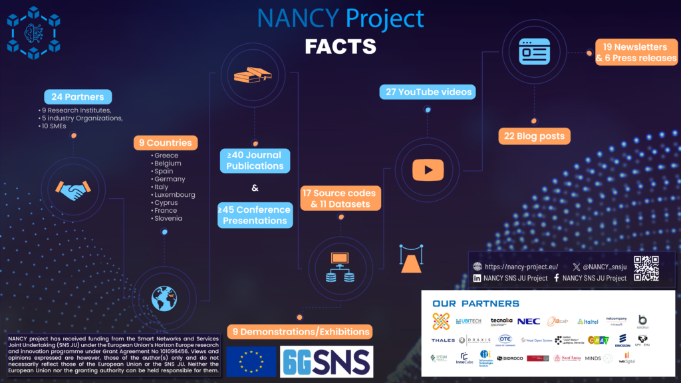
The NANCY project has moved from laboratory research to real-world validation, entering its Proof-of-Concept (PoC) phase. Led by Italtel under the SNS JU, the project is now conducting live trials in Greece, Italy and Spain.
These pilots validate key innovations including AI-driven network orchestration, advanced radio technologies, and quantum-ready security based on post-quantum cryptography and QKD. The objective is to demonstrate more reliable mobility, stronger security and seamless coverage in real operational conditions.
As NANCY concludes its three-year programme, it has also released final deliverables, scientific publications, videos and an infographic, confirming its contribution to secure, intelligent and quantum-ready Beyond 5G network architectures.
XTRUST-6G presents its vision for secure and quantum-safe 6G

The XTRUST-6G project has released a new video outlining its vision for secure, resilient and quantum-safe 6G networks.
Coordinated by Centre for Research & Technology Hellas (CERTH) and involving 20 partners from 12 countries, XTRUST-6G applies a Zero-Trust security model, combining AI-driven threat detection, automated security orchestration and quantum-safe technologies. The project validates its solutions through large-scale pilots, positioning security as a core foundation of Europe’s future 6G infrastructure.
SAFE-6G joins cybersecurity meetup on secure telecom networks
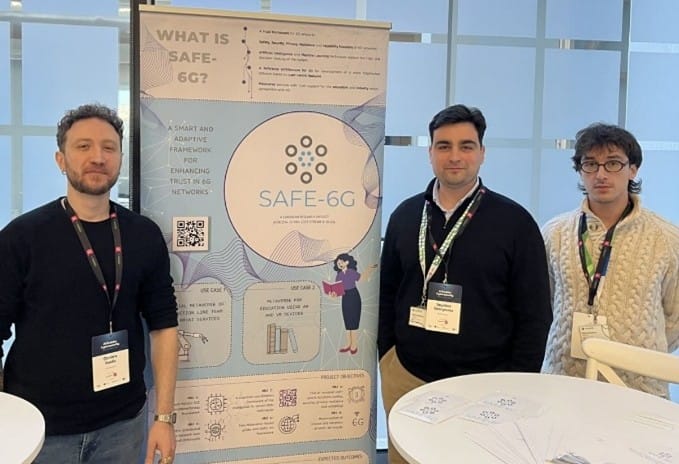
The SAFE-6G project is participating in the cybersecurity meetup organised by the OTE Group of Companies and the Big Data Value Association (BDVA).
The event brings together industry leaders and researchers to discuss cybersecurity challenges and solutions for telecom networks, fostering dialogue and collaboration on secure future connectivity.
Augmented / virtual reality
SEASON demonstrates optical–mobile convergence for XR services

The SEASON project has completed its second major demonstration phase, validating a fully integrated optical–metro–radio orchestration chain to support high-demand Extended Reality (XR) services.
Field trials in L’Aquila leveraged a Spatial PON deployed on a multicore fiber ring, combining SDM-enabled access, programmable packet-optical metro transport and O-RAN mobile connectivity. As XR traffic increased, the system automatically scaled PON lanes, midhaul paths and radio resources in real time, without service disruption.
Results show sub-3-minute service creation, 18–38% energy savings, <1 ms mobile latency, and high-precision monitoring. The demos also confirmed brownfield coexistence with legacy PON, intent-based automated provisioning, and cloud-native readiness, positioning SEASON for real-world deployment of next-generation XR and 5G+ services.
NTN
NexaSphere releases introductory project video
The NexaSphere project has published its first introductory video, presenting its vision and objectives for unified 3D connectivity combining terrestrial, non-terrestrial and aerial networks.
The video outlines NexaSphere’s approach to integrated TN/NTN architectures and introduces its three Proofs of Concept addressing connectivity needs in the aviation, automotive and railway sectors, highlighting how such integration can enable more resilient and seamless future 6G networks.
Sustainability and inclusion
MultiX and 6G4S join forces on Key Value Indicators for 6G

The MultiX project is collaborating with 6G4SOCIETY to advance a common framework for Key Value Indicators (KVIs) within the SNS JU ecosystem.
This joint effort focuses on defining and evaluating KVIs that capture the societal, environmental and economic impact of 6G, complementing traditional technical KPIs. MultiX has contributed to KVI evaluation templates and a “What is a KVI” guide, supporting a shared European approach to measuring the broader value of next-generation networks.
AMBIENT-6G research wins two awards at IEEE 6GNet 2025
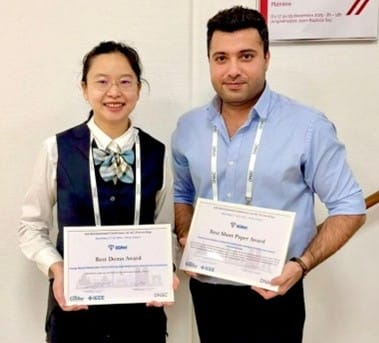
Research conducted within the AMBIENT-6G project at Aalto University received two major awards at IEEE 6GNet 2025 in Paris.
The project earned the Best Demo Award for an energy-neutral ambient backscatter device powered solely by ambient light, demonstrating ultra-low power operation for future 6G Ambient IoT. In parallel, the Best Short Paper Award recognised work on fluid reconfigurable intelligent surfaces, showing improved reliability and covertness for next-generation wireless communications.
Others
IMAGINE-B5G highlighted in Altice Labs’ InnovAction
The IMAGINE-B5G project has been featured in Altice Labs’ InnovAction magazine, recognising its role in advancing the European 5G ecosystem through collaborative innovation and real-world pilots.
The feature highlights IMAGINE-B5G and its Open Call projects as impactful examples of 5G validation across multiple verticals, reinforcing the project’s contribution to bridging research and industrial deployment.
Digital twins for mobility highlighted by 6G-TWIN at MOST workshop
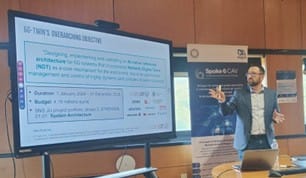
On 22 December 2025, Ion Turcanu, Project Coordinator of 6G-TWIN, from the Luxembourg Institute of Science and Technology (LIST), presented work on digital twins for next-generation mobile networks at a workshop organised by MOST – Centro Nazionale per la Mobilità Sostenibile.
The presentation highlighted challenges in orchestration, interoperability and scalability, underlining the role of digital twins in enabling connected, automated and more sustainable mobility systems.
6G-MUSICAL highlights network-level ISAC at Lecture Series
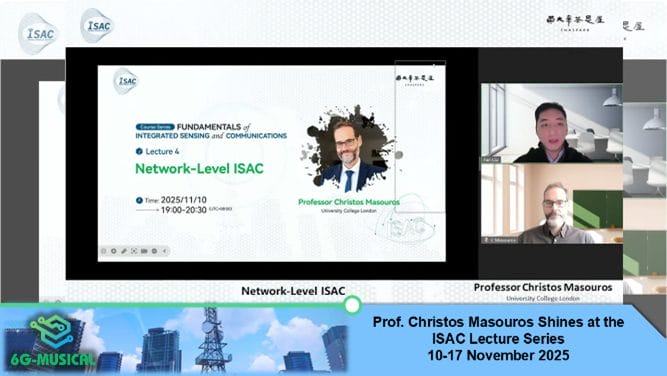
Professor Christos Masouros from University College London (project coordinator of 6G-MUSICAL) delivered two lectures in the Fundamentals of ISAC Lecture Series, co-organised by Chaspark and ISAC-ETI. His talks covered Network-Level ISAC and Security and Privacy in ISAC, addressing distributed sensing, coordination, and emerging security challenges.
The series attracted over 9,500 online viewers and featured leading experts across ISAC foundations, signal processing, edge AI and sensing. Masouros’ contributions helped bridge theory and practice, providing insights relevant to next-generation 6G development, including the 6G-MUSICAL project.
ACROSS Concludes, Paving the Way for Zero-Touch Orchestration in 5G and Beyond
The ACROSS project has successfully completed its 36-month programme, delivering an open and scalable zero-touch orchestration framework for 5G and future networks. Funded under Horizon Europe through the Smart Networks and Services Joint Undertaking, the project addresses the growing need for autonomous management across the edge-to-cloud continuum.
ACROSS validated a hierarchical orchestration architecture combining centralised and distributed components, enabling automated service provisioning, adaptive resource management and AI-supported optimisation across multiple domains. The platform was successfully demonstrated in ETSI ZSM Proof of Concept #16, confirming alignment with key industry standards.
Project results will be further exploited in the European flagship COP-PILOT, while open-source releases ensure long-term sustainability and impact.