
What the SNS JU Trials & Pilots Brochure n°2 Reveals About Europe’s 6G Journey
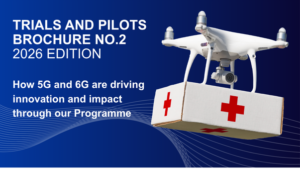 The Future Is Already Being Tested: What the SNS JU Trials & Pilots Brochure n°2 Reveals About Europe’s 6G Journey.
There is often a moment when a technology stops being a promise and starts becoming a reality. Not when it appears in a research paper. Not when it is presented at a conference. But when it leaves the laboratory and proves itself in the real world, under real conditions, with real users.
That moment is captured throughout the second edition of the SNS JU Trials & Pilots Brochure, focusing on twelve demonstrations selected from across the Smart Networks and Services Joint Undertaking portfolio. Together, they offer a snapshot of where Europe stands today on its journey towards advanced 5G and future 6G networks. More importantly, they show where that journey is heading.
Since its launch in 2021, the SNS JU has brought together researchers, industry leaders, innovators and public authorities to build the next generation of connectivity in Europe. The second edition of the Trials & Pilots Brochure highlights a significant milestone in that effort. The technologies featured are no longer confined to simulations or controlled laboratory environments. They are being tested in ports, airports, museums, schools, farms, healthcare settings and public safety operations.
Taken individually, each trial tells a different story.
In Greece, a multi-sensor anti-drone system, developed by FIDAL, known as SwarmCatcher demonstrated how AI and advanced connectivity can help security authorities detect and respond to aerial threats in near real time. In Valencia, the ABySS-5G trial, part of the IMAGINE-B5G project (with Nokia, UTEK, UPV and Telefónica), an autonomous vessel was remotely operated through a 5G network, showcasing how future maritime operations could become safer, more efficient and less dependent on human presence in potentially hazardous environments.
IMAGINE-B5G also explored two further dimensions of what advanced connectivity can deliver. In dense urban settings and large public venues, stadiums, transport hubs, and major events, the project demonstrated that high-capacity, stable network coverage can be extended without building new infrastructure, addressing one of the most persistent frustrations of connected life. On the industrial side, AI-powered visual inspection systems were tested on production lines, detecting microscopic defects with a level of precision that today’s networks cannot support. The result: fewer faulty products, less waste and a stronger case for intelligent manufacturing in Europe.
Elsewhere, researchers explored how connectivity can transform entirely different sectors. At Athens International Airport, TrialsNet proved how AI-powered analytics, thermal cameras and service robots worked together to improve passenger flow and support airport operations.
Also within TrialsNet, a third use case brought advanced connectivity into one of the most demanding scenarios imaginable: mass casualty incidents and emergency rescue in densely populated urban areas. Tested in Athens, the trial integrated wearable devices, robotics, AI analytics and 5G connectivity into a unified emergency coordination system, enabling real-time triage, victim detection and decision support across multiple agencies simultaneously. The results demonstrated ultra-low response latency and high service availability, pointing to a future where connected technology gives first responders a decisive advantage in the most critical moments.
None of this is possible without securing the networks that underpin it. The RIGOROUS project addressed exactly that, developing and testing an automated system capable of detecting, analysing and neutralising cyber threats across complex, multi-domain networks without continuous human intervention. As connectivity becomes more pervasive, the ability to protect it at scale and at speed becomes equally critical. For citizens and organisations alike, that means more resilient digital services across healthcare, transport, finance and public infrastructure: the invisible layer that makes everything else work.
Some of the most striking examples focused on human experience itself.
Visitors at the Museo Nazionale dell’Automobile in Turin stepped into the world of racing legend Alberto Ascari through a shared mixed reality experience, developed by MIAT within the TrialsNet project, transforming cultural heritage into something immersive, collaborative and interactive. The 6G-XR project went even further, exploring a concept that until recently belonged more to science fiction than telecommunications: holographic communications integrated directly into standard mobile calling services. By offloading intensive processing to remote servers, 6G-XR also demonstrated that rich immersive experiences can be delivered through lightweight, everyday devices, removing a key barrier to making extended reality accessible to everyone, not just early adopters with specialist hardware.
Healthcare also emerged as a powerful area of innovation. Developed by 6GPATH, one of the featured pilots demonstrated how nurses working in remote locations could scan chronic wounds, consult specialists through secure communications and produce personalised 3D bioprinted hydrogel patches close to the point of care. The trial offered a glimpse of how future networks could support more personalised and accessible healthcare services, particularly in underserved areas.
In rural Romania, students used immersive XR technologies to participate in new forms of interactive learning, demonstrating, as the 6G-Path results showed, how advanced connectivity can help bridge geographical barriers and expand educational opportunities.
On a vineyard in La Rioja, another 6G-PATH pilot brought precision agriculture into sharp focus. Drones, ground sensors and connected cameras collected real-time data on soil conditions, plant health and irrigation needs, processed automatically to guide farming decisions. Less water, fewer chemical inputs, better harvests, and a more sustainable model for European agriculture at a time when the sector faces mounting environmental pressures.
Perhaps what makes the brochure most compelling is not any individual achievement, but the broader picture that emerges when these projects are viewed together. From Greece and Spain to Romania and Italy, these trials span borders, sectors and communities, a reminder that what is being built here is not a single product or platform, but a shared continental infrastructure.
The advancement of the SNS JU 100 projects portfolio increasingly reflects a transition from experimentation to deployment. In 2025, 469 use cases, together with 224 trials and pilots conducted across priority domains, contributed to the validation of advanced connectivity solutions in operational environments. These activities focus on key sectors, including industry and manufacturing, transport and logistics, healthcare, media, and emergency and safety services, where advanced connectivity has the potential to deliver significant economic and societal benefits.
The rising number of trials and pilots across the programme points to growing technological maturity and greater confidence in real-world validation and uptake of advanced 5G and emerging 6G solutions in real operational settings, helping to bridge the gap between research and market deployment.
This evolution matters because the success of 6G will be measured by whether it helps solve real problems, creates new business and monetisation opportunities and delivers tangible value to citizens, businesses and public services.
The twelve stories featured in the SNS JU Trials & Pilots Brochure No 2 provide compelling evidence that this transition is already underway. From advanced connectivity solutions to innovative use cases across sectors, these examples show that the foundations for next-generation digital infrastructure are being actively built. They highlight not only technological maturity, but also the growing collaboration between industry, research actors and public stakeholders needed to bring these innovations closer to everyday application.
The SNS JU Trials & Pilots Brochure No 2 is a relevant source of information for policy-makers, researchers, public authorities, and private-sector organisations interested in the future of Europe’s digital connectivity.
Read here the Second Trials & Pilots Brochure:
https://smart-networks.europa.eu/the-second-trials-and-pilots-brochure-is-out-now-june-2026/