
Tracking Impact in Europe’s 6G Ecosystem: Inside the SNS JU Trackers Suite
 At the heart of the Smart Networks and Services Joint Undertaking (SNS JU) lies a simple question: how do you ensure that Europe’s investment in next-generation connectivity translates into something tangible?
In a field like 5G and 6G, progress is not always easy to see. Much of it happens at a level that is, quite literally, invisible: in the optimisation of chips, in the behaviour of airwaves and frequencies, and in the performance of complex systems that operate beyond what we can physically observe. It is the result of hundreds of projects, thousands of partners, and a growing number of key industrial sectors. The challenge is not a lack of innovation, but understanding where things are moving, how fast, and with what impact.
This is where the SNS Trackers Suite comes in.
The Trackers are a set of tools designed to monitor evolving research while assessing its wider impact.
From research to real-world use
One of the defining features of the SNS JU approach is that 6G is not being developed in isolation. It is shaped together with the industries that will eventually use it. The Vertical Engagement Tracker reflects this idea. It captures how research moves from concept to application across sectors such as mobility, manufacturing, health, media or energy.
Looking at the VET Tracker, the picture becomes more concrete. You can explore hundreds of use cases (from early experiments to large-scale pilots) each linked to a specific sector, tested in a defined environment, and positioned along a clear maturity path. Some focus on immersive communication, others on smart mobility or industrial automation. Together, they show where 6G is already being tested in real conditions, and where it is still taking shape.
Equally important is the role of Vertical Associations, which are also mapped within the tool. These organisations bring the perspective of industries with very practical constraints, helping to ensure that technological development is aligned with real needs. What might otherwise remain a high-level objective, becomes something visible and traceable.
From research to global standards
If use cases show where value can be created, standardisation determines whether that value can scale.
This is the focus of the Standards Tracker. Standardisation often takes place behind the scenes, in technical groups and working documents, yet it is where research outcomes gain long-term relevance.
The Standards Tracker makes this process more accessible. It follows how SNS JU projects contribute to pre-standardisation activities, maps relevant telecommunications standards, and provides visibility on the work of different Standard Development Organisations (SDOs). For project teams, this means understanding where their contributions fit. For new stakeholders, especially from outside telecom, it lowers the barrier to entry into what can otherwise seem like a closed ecosystem. In this way, the Standards Tracker supports one of the SNS JU’s core objectives, which is ensuring that European research contributes coherently to the global definition of 6G.
Measuring progress along the way
While business engagement and standardisation provide direction, progress also needs to be measured.
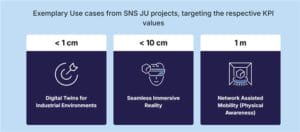
The KPI Radars address this by bringing structure to a highly diverse research landscape. The Technical Radar focuses on performance targets (what 6G is expected to deliver in practice) but does so without forcing everything into a single benchmark. Instead, it reflects the diversity of use cases by showing the range of values projects are working towards, always linked to real experimental contexts.
For example, in the area of positioning and localisation, some projects are already targeting sub-meter accuracy with very high reliability, as explored in initiatives such as Hexa-X-II. These targets are not abstract figures; they are tied to concrete use cases where precise and reliable positioning is critical, helping to illustrate how performance ambitions translate into real-world applications.
 Alongside this, the Programme Radar looks at the broader picture. It tracks how projects contribute to the ecosystem: how many sectors are involved, how SMEs participate, how results feed into scientific output, standards, open-source initiatives or outreach activities. It becomes possible to see not only technical progress, but also how a research programme builds momentum over time.
A connected view of progress
What makes the SNS Trackers Suite distinctive is how these elements come together.
Each tool answers a different question: where 6G is being applied, how it contributes to global standards, and how progress can be measured. Taken together, they provide a more complete picture, one that different audiences can read in different ways. Policymakers can assess strategic alignment, industry can identify opportunities, researchers can benchmark their work, and a wider audience can better understand how European funding translates into concrete outcomes.
The Trackers are also not static. As projects evolve, new use cases emerge, standards progress and partnerships grow, the tools are updated to reflect these changes. They evolve alongside the ecosystem they are designed to observe.
In the end, their role is quite straightforward: to make innovation easier to follow, easier to understand, simpler to track.
? Discover the SNS Trackers Suite: https://sns-trackers.sns-ju.eu/