
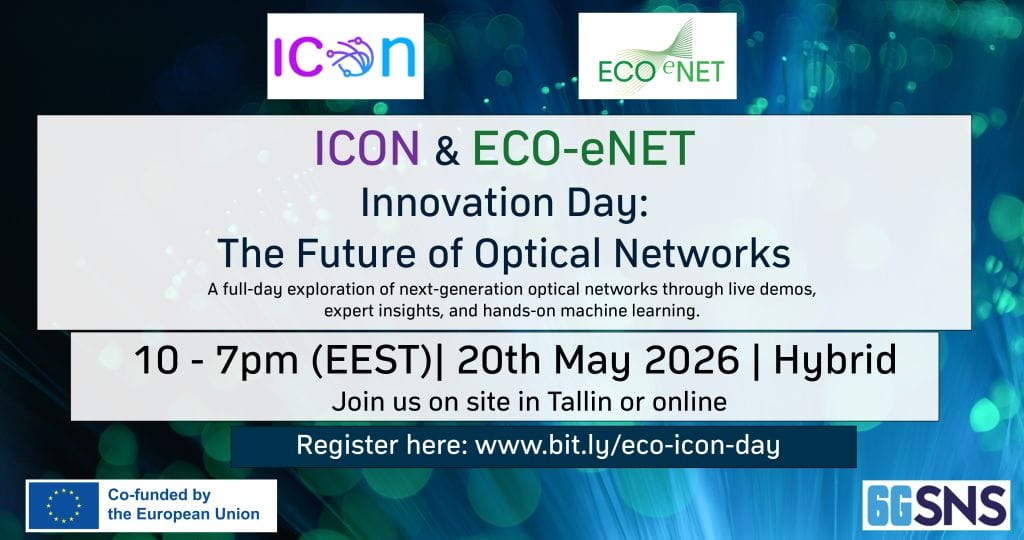
Join us for a joint workshop between the ICON Project and ECO-eNET Project, bringing together researchers, industry, and public sector stakeholders to explore the challenges and opportunities in shaping efficient, resilient, and scalable future infrastructure.
Date: 20 May
Time: 10:00–19:00
Location: Tallinn University of Technology (Hybrid event)
Please note the time zone for this is Eastern European Summer Time(EEST)
This full-day event combines live demonstrations, expert talks, and a hands-on hackathon to explore the future of optical networks. Participants will engage with cutting-edge sensing technologies, next-generation communication systems, and real-world applications across critical infrastructure.
From interactive demos and collaborative discussions to practical machine learning sessions using optical sensing data, the programme highlights the evolving role of optical networks in building resilient, intelligent, and future-ready systems.
Register here to attend: https://bit.ly/eco-icon-day
Event Programme for ECO-eNET & ICON Innovation Day: The Future of Optical Networks
10:00 – 12:00 (EEST) | Interactive Demo: Exploring the Sensitivity and Precision of the modern Optical Sensing Devices
Within 40 years, optical fibers have become the primary infrastructure for secure high-speed communications and millions of kilometers are deployed all around the world.
Beyond data transmission, this pervasive infrastructure is increasingly leveraged for environmental sensing, giving rise to the emerging field of joint communication and sensing. These capabilities enable the detection and localization of anomalies and disturbances, supporting new operational models across multi-vendor, multi-operator, and multi-technology domains, and paving the way for large-scale sensing grids.
The interactive demo at Tallinn University of Technology (TalTech) showcases state-of-the-art sensing and communication technologies, including modern 600 Gbit/s transceivers, State of Polarization analyzers, Distributed Acoustic Sensing (DAS), and Optical Time Domain Reflectometry (OTDR). Visitors can actively interact with the fiber infrastructure by introducing controlled disturbances, while real-time system responses are visualized to assess sensitivity and precision.
In addition, Discrete Variable Quantum Key Distribution (DV-QKD) systems provided by Metrosert are integrated into the same setup, allowing participants to observe how physical disruptions impact secure key generation rates.
Register here to attend: https://bit.ly/eco-icon-day
12:00 – 16:00 (EEST) | The Invisible Optical Backbone: Sensing and Networking Challenges for Critical Infrastructure
A collaborative workshop between ECO-eNET and ICON partners.
Optical fiber networks are part of the invisible backbone of our digital society.
Yet their complexity, vulnerabilities, and untapped potential remain largely hidden from public view.
This workshop brings together researchers and practitioners to explore the challenges and opportunities at the intersection of optical sensing and next-generation optical networking, with a focus on critical infrastructure in the Baltic region and beyond.
Topics will span the full stack: from confluent networking concepts and spectrum-as-a-service, to telemetry, to the use of optical fibers as sensors for monitoring mission-critical infrastructure.
We will also cover emerging link technologies, including THz and free-space optical communications, sensor grid deployments, and the application of machine learning to optical network data.
Register here to attend: https://bit.ly/eco-icon-day
17:00 – 19:00 (EEST) | Hackathon: Exploring the Backbone: A Guided Journey into ML for Optical Sensing
Optical fibers carry vast amounts of data about the physical world around them — yet extracting meaningful insights from this data can seem daunting without a background in coding or machine learning. This session is designed to change that.
Building on the morning’s outdoor sensing trial, participants will be guided through a hands-on exploration of real optical sensing data using pre-prepared code running directly in their browsers — no installation, no programming experience required.
A short introductory lecture will cover the key concepts of machine learning applied to optical network data, before participants dive in, tweak parameters, and see the results change in real time.
The goal is not to turn anyone into a programmer, but to make the power of ML for optical sensing tangible and accessible to all.
Register here to attend: https://bit.ly/eco-icon-day
 The projects have received funding from the Smart Networks and Services Joint Undertaking (SNS JU). The JU receives support from the European Union’s Horizon Europe research and innovation programme. Views and opinions expressed are however those of the author(s) only and do not necessarily reflect those of the European Union. The European Union cannot be held responsible for them.